Home / Services / Rhinoplasty

Rhinoplasty & Nose Reshaping

Achieve facial harmony and improve breathing with a customized rhinoplasty. We utilize advanced surgical techniques to refine your nasal bridge, tip, and profile while preserving your unique ethnic identity.

15+
Years of surgical expertise
1500+
Rhinoplasty procedures
Both
Functional & Aesthetic
ISO-9001
Certified clinical facility

Balancing Form and Function

The nose is the central anchor of the face. A successful rhinoplasty (commonly known as a nose job) does not aim for a one-size-fits-all shape, but rather seeks to balance the nose with your individual facial proportions (eyes, chin, and jawline). Beyond aesthetics, we prioritize structural integrity, frequently integrating septoplasty to correct breathing issues simultaneously.

Structural Preservation

Instead of simply removing tissue which can cause collapse over time, we expertly reshape and graft your native cartilage to ensure a strong, lifelong nasal foundation.

Functional Integration

We routinely perform functional rhinoplasty (septorhinoplasty) to correct a deviated septum, enlarged turbinates, or collapsed internal valves to drastically improve airflow.

Are You a Candidate for Rhinoplasty?

Candidates seek rhinoplasty for a variety of cosmetic and medical reasons. Ideal candidates have fully matured facial bones and seek improvement, not absolute perfection.

Ideal Candidates

  • Bothered by a prominent dorsal hump or wide bridge
  • Have a bulbous, drooping, or overly projected nasal tip
  • Suffer from breathing issues due to a deviated septum
  • Wish to correct asymmetry or crookedness from past trauma
  • Are generally over the age of 16-18 (when facial growth is complete)

Needs Evaluation

  • Expecting to replicate a celebrity's nose exactly
  • Have severely thick, sebaceous skin (which limits tip refinement visibility)
  • Active smokers (nicotine severely impairs cartilage healing)
  • Have had multiple previous unsuccessful nose surgeries (requires complex revision)

Surgical Precision in a Sterile Environment

Rhinoplasty is a surgery of millimeters. Our ISO-9001 certified surgical suites are equipped with state-of-the-art lighting and micro-surgical instruments, ensuring that every osteotomy (bone adjustment) and cartilage graft is performed with absolute precision under the care of board-certified anesthesiologists.

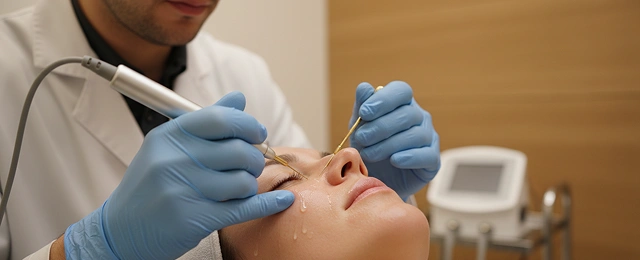
Clinical aesthetic surgical suite

Our sterile surgical environment is designed for intricate, micro-precision facial procedures.

Surgical Rhinoplasty vs. Liquid (Filler) Rhinoplasty

While dermal fillers can temporarily camouflage a small bump by adding volume around it, they cannot make a nose smaller, narrow a wide tip, or fix breathing issues. Surgery is the only permanent, structural solution.

Factor Surgical Rhinoplasty Liquid Rhinoplasty (Fillers)
Mechanism Permanently reshapes underlying bone and cartilage Injects hyaluronic acid gel under the skin
Size Reduction Can reduce overall size, width, and tip bulk Adds volume only; cannot make the nose smaller
Functional Fixes Corrects deviated septums and breathing problems Cosmetic only; no effect on breathing
Longevity Permanent, lifelong results Fades in 9 to 18 months; requires retreatments
Downtime 1 to 2 weeks for initial recovery Immediate, with potential for minor bruising

The Surgical Process

Depending on your anatomy, your surgeon will perform either an "Open" or "Closed" rhinoplasty.

1

3D Facial Mapping & Consultation

We analyze your facial proportions from multiple angles. We discuss the exact aesthetic changes you desire and examine the internal nasal structures to ensure functional breathing improvements are included.

2

Anesthesia & Incisions

Under general anesthesia, the surgeon makes incisions. In a Closed Rhinoplasty, incisions are hidden inside the nostrils. In an Open Rhinoplasty, a tiny incision is made across the columella (the skin between nostrils) for maximum visibility in complex cases.

3

Structural Reshaping

The skin is gently raised. Bone and cartilage are then meticulously reduced, augmented, or rearranged. We may use cartilage grafted from your septum to build a stronger tip or straighter bridge.

4

Septum Correction (If Needed)

If your septum is deviated, it is straightened at this time, and any internal obstructions are cleared to optimize nasal airflow.

5

Closure, Splinting, & Cast

The incisions are closed with fine sutures. A small external cast or splint is placed on the bridge to protect the new shape and reduce swelling. Internal silicone splints may be temporarily used to support the septum.

Your Recovery Journey

Rhinoplasty requires patience. While the cast comes off quickly, the final micro-swelling takes months to fully resolve.

Day 1–3
You will wear an external cast and feel congested, similar to a heavy cold. Swelling and potential bruising around the eyes peak. You must sleep with your head elevated.
Day 7–10
Your cast and any external sutures are removed at the clinic. Bruising begins to fade. Your new nasal profile is visible, though still quite swollen. Most patients return to work.
Week 4–6
About 60-70% of the swelling has subsided. You may resume strenuous exercise. You must avoid wearing heavy glasses resting on the bridge of the nose.
Month 6–12
The final 20% of swelling—especially in the nasal tip—slowly resolves. The skin fully shrink-wraps to the new cartilage framework, revealing your permanent, refined result.

Honest About Risks, Serious About Safety

Rhinoplasty is one of the most complex cosmetic procedures. We prioritize structural preservation to prevent long-term complications, but it is vital to understand the surgical realities.

  • Temporary numbness in the nasal tip and upper lip is very common and typically resolves within a few months as nerves heal.
  • Minor asymmetries may persist, as no human face is perfectly symmetrical. The goal is profound improvement and harmony, not mathematical perfection.
  • Breathing may feel temporarily restricted during the first few weeks of recovery due to internal swelling and mucus buildup.
  • Revision rhinoplasty (a secondary surgery) is sometimes necessary globally in about 5-10% of cases if the cartilage heals unpredictably over the first year.
PROVEN RESULTS

Rhinoplasty Results

×
After Before
Before After

Frequently Asked Questions

Is rhinoplasty painful?

Most patients are surprised to find that rhinoplasty is not highly painful. It is more accurately described as uncomfortable. The primary sensation is nasal congestion (like a severe head cold) and dull pressure during the first few days.

Will I have an open or closed rhinoplasty?

This depends on your anatomy and goals. Closed rhinoplasty hides all incisions inside, making it great for minor bridge adjustments. Open rhinoplasty involves a tiny incision on the columella, providing unparalleled visibility for complex tip refinement and structural grafting.

Can I wear my glasses after surgery?

You cannot wear glasses resting on the bridge of your nose for 4 to 6 weeks after surgery, as the weight can shift the healing bones. You must tape your glasses to your forehead or switch to contact lenses during this time.

Will insurance cover my rhinoplasty?

Insurance does not cover rhinoplasty performed purely for cosmetic reasons. However, if a portion of the surgery is functional (like a septoplasty to correct documented breathing issues), that specific portion may be eligible for reimbursement by your provider.

How long will my nose be swollen?

The majority of visible swelling subsides within 3 to 4 weeks, allowing you to look great in photos and social settings. However, the final 10-20% of micro-swelling in the nasal tip can take a full 12 to 18 months to completely dissipate.

Will my voice change?

If you have a severely deviated septum blocking airflow (giving you a "nasal" or congested sounding voice), correcting it may slightly clear up your vocal resonance, but it will not drastically change the fundamental sound of your voice.

Book Consultation +92 336 5269417